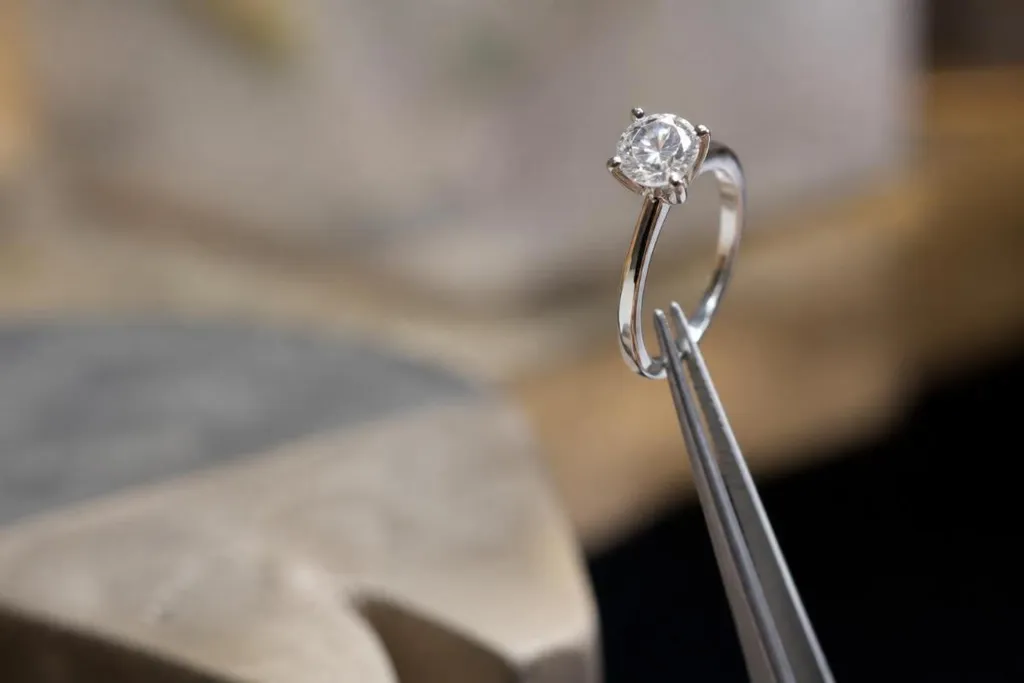
A ring band does not have to become wider or more decorative to gain character. Sometimes changing the profile is enough. A knife-edge band uses a subtly raised central ridge rather than presenting a uniformly flat or rounded outer surface. This creates two angled planes that catch light independently, giving the shank greater definition while preserving a relatively streamlined appearance. On an engagement ring, that small structural change can also guide attention naturally towards the centre stone.
For someone who already likes the fundamental design of their ring but wants a more distinctive profile, this upgrade offers a way to introduce additional dimension without relying on pavé diamonds, engraving or a broader band. The result can feel architectural and refined, particularly when the proportions of the ridge are carefully balanced with the centre setting.
What Makes a Knife-Edge Profile Different?
Despite the name, a well-designed knife-edge ring is not intended to feel literally sharp. The term describes the visual profile created by two surfaces meeting along a defined central line.
Compared with a conventional rounded band, this structure changes how light moves across the metal. One side of the ridge may appear bright while the opposite plane falls into softer reflection, making the band look more dimensional as the hand moves.
This can be particularly effective in a solitaire. With no shoulder diamonds or elaborate decoration, the shape of the shank becomes an important part of the design. The ridge creates interest without challenging the centre stone for attention.
It also offers an alternative for someone who finds a very plain band slightly too minimal but does not want additional gemstones. The detail comes from craftsmanship and geometry rather than embellishment.
Creating Presence Without Increasing Width
Band width has a considerable effect on how an engagement ring looks on the finger. A broader shank can provide visual strength, but it can also make a delicate centre setting feel heavier.
A knife-edge profile offers another route.
Because the raised ridge creates highlights and shadow, the band can appear more defined without requiring substantially greater width. This allows the shank to retain a fine overall footprint while having more visual structure than a conventional flat or softly rounded profile.
That balance can be useful around a prominent centre diamond. Someone choosing a 2-carat stone, for example, may want the band to have enough definition to support its scale without adding unnecessary width. A knife edge can provide that sense of structure while keeping attention focused towards the centre.
With a smaller diamond, the same profile can give a simple solitaire more personality without overwhelming its proportions.
The goal is not to make the band appear larger, but to make its existing dimensions work harder visually.
How Metal Choice Changes the Effect
Knife-edge detailing is particularly dependent on light, so metal choice influences how strongly the profile is perceived.
Platinum and white gold create a cool, crisp appearance. Their bright surfaces can emphasise the transition between the two angled planes, making the central ridge feel precise and contemporary.
Yellow gold produces a warmer interpretation. Highlights moving across the angled surfaces can emphasise the richness of the metal, giving a geometrically structured band a more traditional fine-jewellery character.
Rose gold softens the effect further through its warmer pink tone. This can be appealing for someone who likes the architecture of a knife edge but wants the overall ring to retain a romantic quality.
The profile can therefore adapt to several aesthetics. Its geometry does not automatically make the ring stark or ultra-modern; much depends on the chosen metal, centre stone and setting.
Comfort, Wedding Bands and Everyday Wear
Profile should always be considered alongside comfort. Although the top of a knife-edge band has a defined ridge, the surfaces that contact the finger should still be finished for everyday wear.
The design also affects bridal pairing. A plain wedding band can provide contrast against the more sculpted engagement-ring shank, while a similarly refined band can create a highly coordinated stack.
Width matters here too. Keeping the wedding ring proportionate prevents the combined set from becoming visually heavy, especially if the engagement ring was chosen specifically for its streamlined character.
Everyday care is straightforward. Regular cleaning helps preserve the reflective surfaces that make the knife-edge profile noticeable. As with any fine jewellery, removing the ring during heavy manual activities can reduce deeper scratches and unnecessary knocks.
Over time, surface wear may soften the original polish, so occasional professional refinishing can restore greater definition if desired.
Final Thought
A knife-edge band shows how profile can be just as influential as width. Its raised central ridge introduces light, shadow and architectural definition without requiring extra diamonds or elaborate decoration.
For someone refining a solitaire or another clean engagement-ring design, it offers a subtle way to make the shank feel more considered. The change is restrained, but that is precisely its strength: the band gains personality while the centre stone remains unquestionably the focus.